
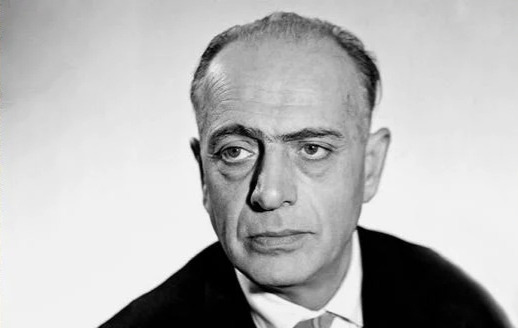
Karo Halabyan’s career fused the revolutionary fervor of post-Genocide Armenia with Stalinist Empire’s axial grandeur, elevating him from Elizavetpol schoolboy to Moscow’s chief architect and USSR Academy vice president. Born July 26, 1897, in Ganja to an Armenian family, he navigated civil war chaos via Tiflis’s Nersisyan School classmates with future Politburo titan Anastas Mikoyan before Vahan Teryan’s Moscow entrée. Graduating Vkhutemas in 1929, Halabyan bridged Tamanian’s Yerevan romanticism and Zholtovsky’s neoclassic weight, scripting Stalingrad’s rebirth and Moscow’s metro pomp across three decades.
Revolutionary Roots in Yerevan
Arriving post-1920 Sovietization, Halabyan’s 1920s Yerevan commissions Builders Club, Electrochemical Trust housing marked early post-constructivism: asymmetrical frames pierced by classical pediments, tuff accents nodding to Tamanian’s palette. These functionalist hybrids aided refugee reconstruction, blending khachkar silhouettes with concrete efficiency amid Alexander Tamanian’s radial oversight. His intuitive synthesis caught Bolshevik eyes, launching Moscow migration by 1932.
[image unavailable; picture neoclassical Yerevan clubhouses rising amid Ararat’s haze.]
Moscow Empire and Stalingrad Phoenix
As USSR Architects Union secretary (1932–1950), Halabyan championed “national forms in socialist content” Corinthian orders rationalized for proletarian scale. Chief Moscow architect, he orchestrated Stalingrad’s 1943–1945 masterplan: Volga-facing radials resurrecting 90% razed city, symmetrical axes channeling Tamanian logic on apocalyptic canvas. Masterpieces: Central Academic Theatre of Russian Army (with Simbirzev; colonnaded stage for Red Army glory), Krasnopresnenskaya Metro station (with Ilyin; coffered vaults echoing Etchmiadzin), Sochi Sea Port terminal (1955; Stalinist seaside with rhythmic pilasters). These fused Ivan Fomin’s symmetry with constructivist voids, perfect for Victory parades.
Armenian Imprint and Stylistic North Star
Halabyan’s Yerevan seedworks influenced Tamanian School successors; Kievyan-Halabyan Street (modern name) spans bridges honoring his urban spine. His “innovative classicism” oversized porticos framing glass curtainwalls nationalized Soviet pomp, pomegranates and grapevines incised into socles. Stalingrad’s avenues anticipated Khrushchev’s 1955 decongestions; Moscow metro stations prefigured post-Stalin utility. Amid Merzhanov’s dachas and Tamanian’s tuff cores, Halabyan uniquely scaled Armenian motifry to imperial theaters.
Institutional Colossus and Honors
USSR Academy vice president, Supreme Soviet deputy (1937–1950), Halabyan shaped architectural doctrine through purges unlike Merzhanov’s exile. Armenian SSR Merited Artist (1940), his 2021 Moscow statue (Don River origin nod) joins Tamanian’s Cascade vigil. Died January 5, 1959; Novodevichy Cemetery neighbors Soviet immortals.
Pantheon Among Titans
Halabyan crowned Armenian Soviet architectural pantheon: Tamanian localized Yerevan, Merzhanov personalized Stalin, Mesrobian Deco’d exile yet Halabyan imperialized both, Ganja youth scripting Volgograd boulevards and Moscow vaults. His Kievyan span pulses from Ararat to Kremlin, neoclassic shells incubating socialist eternities perfect bridge from tuff sovereignty to empire’s golden pediment.
