

The longest reversible cable car in the world now transports an unprecedented number of visitors to this historic site.
In the years leading up to 2010, the historic Tatev Monastery in the Syunik region of Armenia was experiencing difficulties. The number of visitors was declining, and the complex of medieval buildings itself was in desperate need of restoration. During its heyday, the 9th century monastery was a thriving medieval university specializing in both academic and spiritual studies, but at the turn of the millennium, the historic site, located on a plateau on the edge of the picturesque Vorotan Gorge, was very much in the air. Few people at the time expected that the path to restoring ancient frescoes and handmade masonry would be built using 18,871 feet of cutting-edge steel wire and a Guinness World Records certificate.
Despite the stunning exterior, the secluded location of the monastery created problems for its maintenance. “In the early 2000s, this part of Syunik, where the monastery is located, was one of the poorest and most inaccessible regions, with high unemployment and minimal investment opportunities,” Ruben Vardanyan, a social entrepreneur and co-founder of the IDEA Foundation, said in a statement. Smithsonian.com . “Theoretically, at least, Tatev could become a key point of the tourist route that connects Yerevan with Artsakh and Southern Armenia, but due to its remoteness, it is unlikely that it will be included in organized tourist routes. The local authorities did not have the funds to reconstruct the road to the monastery, and given the harsh winters and sparsely populated surrounding villages,
In an effort to revitalize the monastery and the surrounding areas, Vardanyan, together with his partners and friends, launched the Tatev Renaissance project. Some of them worked with the Austrian-Swiss company Doppelmayr/Garaventa to create the ultramodern Krylia Tateva tram, the longest reversible cable car in the world. It stretches for more than three and a half miles from Syunik to Tatev and hovers at an altitude of about 1,000 feet above the Vorotan River gorge. Now visitors can reach the medieval site in about 12 minutes, and with the advent of the tram, the number of tourists has increased dramatically.
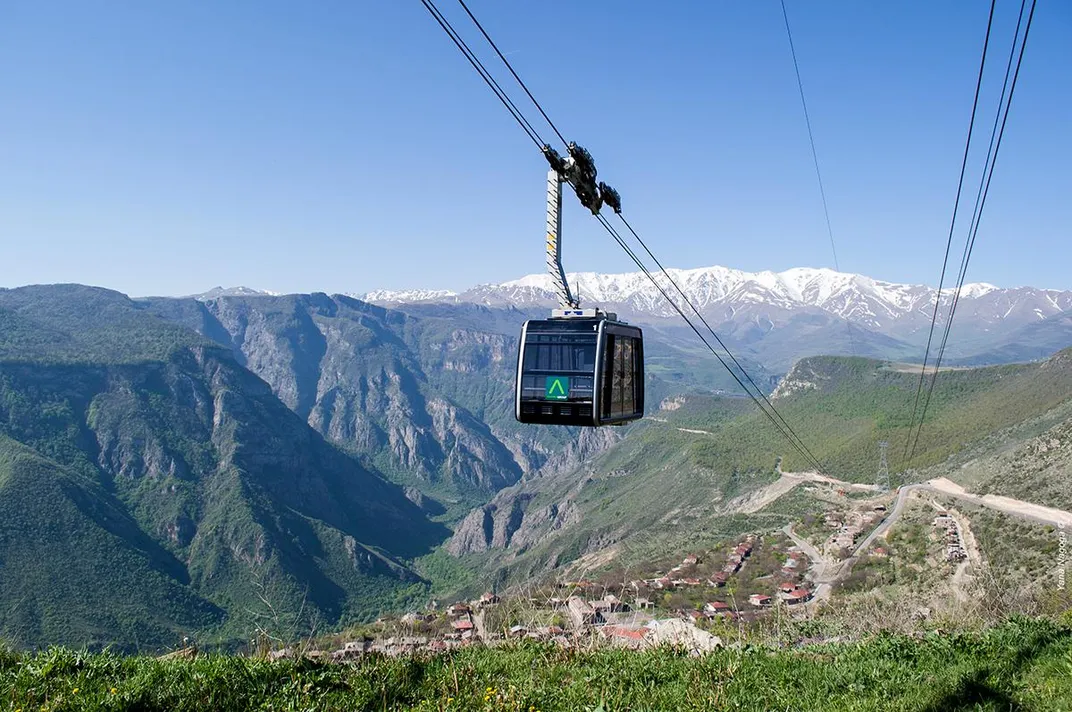
“Before the construction of the Tatev cable car, only a small number of people could walk along the broken and rather dangerous mountain hairpin,” Vardanyan noted. “For example, during 2009, the monastery was visited by about five thousand tourists, [whereas] today it attracts about 20 percent of the total tourist flow heading to Armenia. The Wings of Tatev have become a new attraction in their own right. Since the launch of the cable car, more than 640,000 tourists have used it not only from Armenia, but also from Russia, the USA, Europe and Asia.”
A round trip costs about $10 in the summer months, and the proceeds go mainly to help with the ongoing renovation of the monastery. As the monastery’s popularity has grown, it has also attracted new government funding, and as a result, the IDEA Foundation is now also funding additional projects in the community. Since the cable car opened, locals have begun training in the hospitality industry to accommodate the more than 20 new bed and breakfast hotels that have opened in the nearby town. IDEA helps the same local residents to make business plans and apply for loans. And there are 50 local residents working in Tatev Wings itself.”
“Together with various stakeholders,” Vardanyan explained, “we are developing the logistical and educational infrastructure in nearby villages: we are improving the water supply and street lighting system, improving road safety, building playgrounds, repairing schools and preschools, opening engineering laboratories in local schools, etc. Our activities also include environmental protection: planting trees, garbage collection and installation of garbage cans in populated areas, general maintenance of natural monuments.”
As a result of the Tatev Renaissance project, the monastery was able to reopen its doors as a cultural center in the community, as well as a tourist destination. Church holidays are celebrated again within its walls, and the Tatev Monastery Choir performs regularly. It also hosts theatrical performances, concerts, festivals, and even sporting events.
Sources: Jennifer Billock —Smithsonian Magazine
