

Martiros Saryan is the number one Armenian artist, and today marks his 140th birthday. His name is known all over the world. The painter is a landmark for both Russia and Armenia, because Saryan spent his youth in Nakhichevan, in the Rostov steppes, and then studied in Moscow at the School of Sculpture and Architecture. Before finally moving to Yerevan, Saryan, while still a student, often travels to Armenia and the Caucasus. It is these trips that lead him to understand his own roots, complete the missing and most unique puzzle to his personality — the personality of the artist. The story of the Armenian Museum of Moscow tells how this happened.
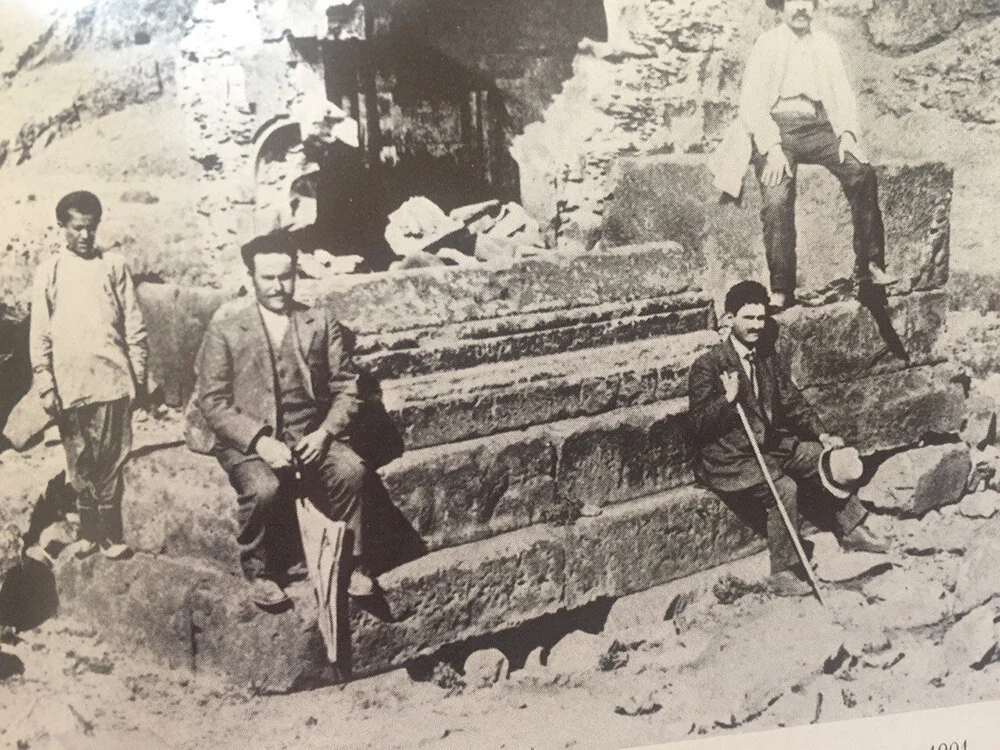
In the summer of 1901, the artist, together with his friend, sculptor and native of Yerevan Gevorg Miansaryan, makes his first trip to Armenia. Besides Yerevan, friends also visit its nearest neighborhoods — Etchmiadzin, Ashtarak, Sevan. The architecture, landscapes and people of Armenia make an indelible impression on the young artist. He is inspired, charmed, and full of plans for the future.
“I have long dreamed of the Caucasus and Transcaucasia, and although I have visited the North Caucasus several times, I have not been particularly captivated by it. But the Middle Caucasus and especially the Southern Caucasus fascinated me; here I saw the sun for the first time and experienced the heat. Caravans of camels with bells descending from the mountains, nomads with tanned faces, with herds of sheep, cows, buffaloes, horses, donkeys, goats; bazaars, the street life of a motley crowd; Muslim women, silent, gliding in black and pink veils, in purple trousers, in wooden shoes peeking from the flat roofs of square houses; the big dark almond—shaped eyes of the Armenian women – it was all real, which I dreamed about as a child. I felt that nature was my home, my only solace; that my delight in it was different from that of works of art.: it only lasts a few minutes. Nature is multifaceted, multicolored, forged by a strong, unknown hand — my only teacher,” Saryan shared his impressions in his autobiography “From my Life.”
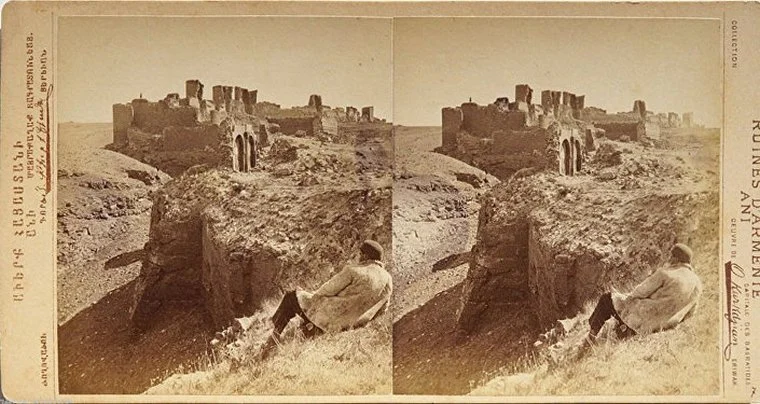
What Saryan absorbs in Armenia was really a powerful feeling, but, as the researcher of the Armenian artist’s work notes [D. Sarabyanov. — Editor’s note], “the impressions, although very strong, were so new that they could not immediately be reflected in his works performed here in Armenia. However, these impressions gave rise in the artist to some still vague, vague ideas about completely new forms of depicting nature.”
These summer trips to Armenia were not fruitful in terms of finished works — few of them have been preserved. But traveling gave Saryan something more — a sense of homeland, land, smell and color.
What places did young Saryan visit?
In his autobiography “From My Life,” Saryan writes that in 1902, during his second trip to Armenia, he visited Ani, a place of worship for every Armenian. The artist remembers with deep respect the archaeologist Nikolai Marr, who was the first to start excavations in ancient Ani. Saryan was struck by the Armenian monuments of ancient architecture with amazing originality, plastic grace and monumentality of architectural forms. He noted the amazing harmony combined with the mountain landscape of all the structures he saw, both pagan and Christian.
According to the researcher of Saryan’s painting, the Russian art critic Dmitry Sarabyanov, the landscape “Makravank” is very interesting for describing Saryan’s work of those years. The researcher believes that “nothing else in this dark-colored and gloomy landscape foreshadows the bright colorful Saryan that it later became.” According to Sarabyanov, during these trips Saryan still had strong skills laid down in art School, and the painter’s perception of nature was largely due to the Moscow “school”. Nevertheless, the new impressions received by the artist from trips to Transcaucasia did not remain fruitless. Saryan feels a growing sense of dissatisfaction with what he has done so far, and new ideas about the tasks of art are emerging.
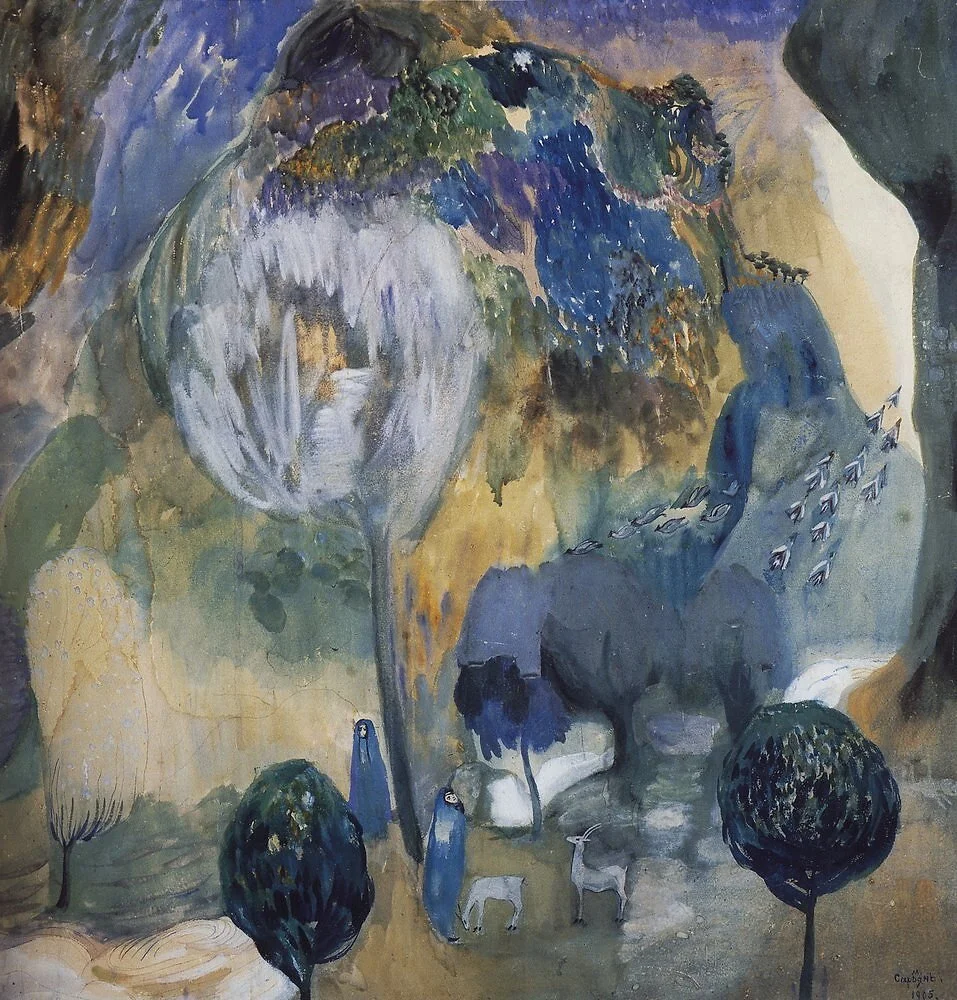
While staying in Armenia, Saryan loved to take night walks, which allowed him to admire the moonscapes. His trip to the Akhuryan gorge on a clear moonlit night is described, the landscape of which Martiros Saryan gives the most sublime epithets. “The moon, which had risen to the zenith, illuminated with silvery brilliance a gloomy gorge with steep basalt slopes and a river noisily snaking over rocks.” The impressions of the ruins he saw, the sound of a mountain river, the barking of a dog and distant human voices — all this plunged the imaginative young artist into a special, mysterious world full of obscure signs.
Later, he painted the painting “In the Akhuryan Gorge”, which was included in the collection of the Blue Rose association of symbolist artists, to which Saryan joined for some time. The landscape reflects the anxiety, expectation of change by the young artist and the uncertainty associated with it.
Saryan speaks with great love about the people he met in Armenia. In Ani, the artist and a friend stay in the house of a hospitable monk, who cordially treats the young men with fresh cucumbers, butter, lavash and cheese. This is an undemanding dinner of a simple black man, which travelers consume, as Saryan recalls, “with an appetite.”
In the same “unsightly but warm room,” Toros Toramanian, the author of the major work “Armenian Architecture,” worked in a corner by lamplight. Saryan got to know the scientist, and he impressed him with “steadfastness and nobility.” Many years later, Saryan would paint Toramanyan’s portrait.
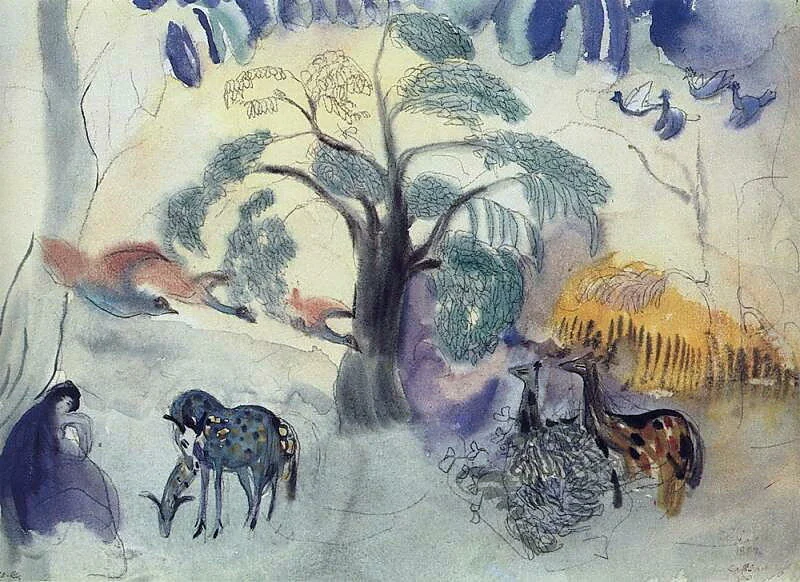
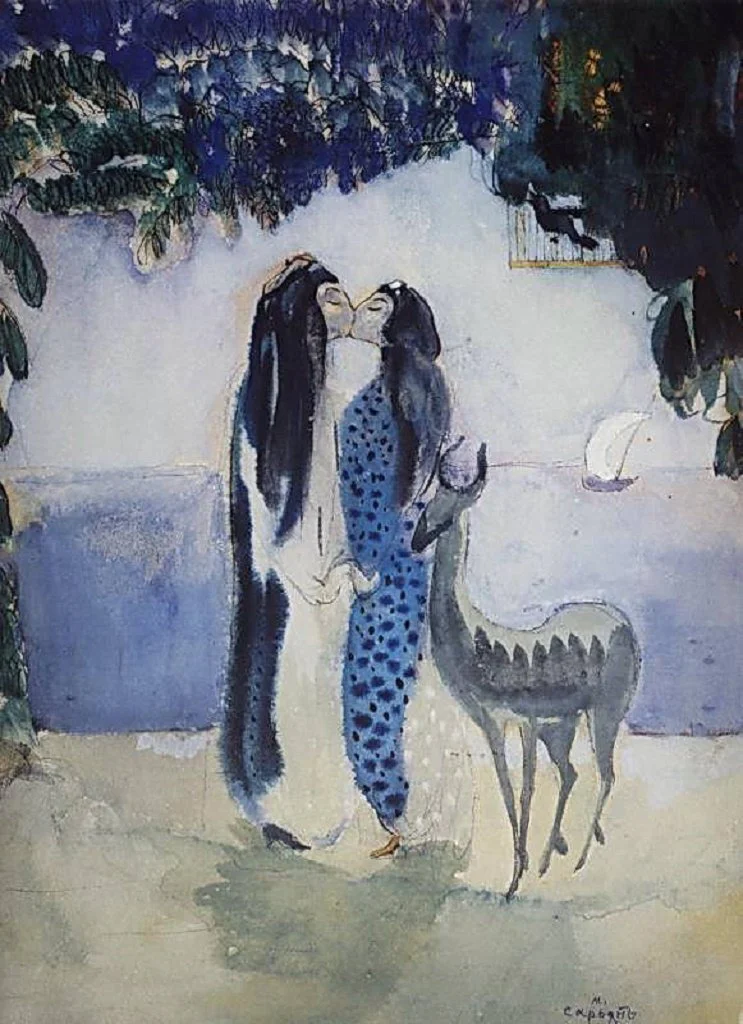
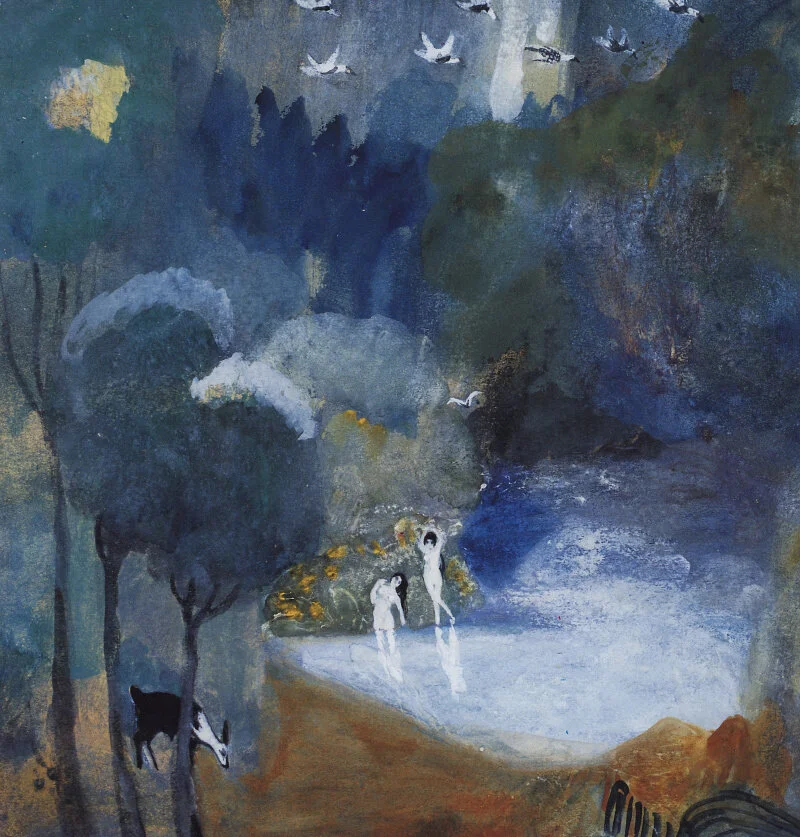
Other works of this, the very first, Armenian cycle — “Fairy Tale”, “Enchantment of the Sun”, “Love”, “Poet” and “Lake of Fairies” — were written during the annual trips of the young artist, which became traditional for him at the very beginning of the 20th century.
During the trip, Saryan also felt in love — on the way he and his friend were accompanied by two Armenian girls, Ashkhen and Satenik. “I looked at them as if fascinated, studying the shapes of the nose, lips, and wonderful southern-type profile, the charm of which was further accentuated by thick black hair flowing over her shoulders.”
During these years, Saryan traveled the length and breadth of Armenia and almost the entire Transcaucasia. He also visited Georgia. It was there, not far from the town of Akhalkalaki, inhabited by ethnic Armenians, that Saryan met a blacksmith on a night road, who showed him the high-altitude Chaldyr lake, which the artist firmly set out to find as soon as he learned of its existence. The blacksmith told the impressionable artist an ancient legend related to the lake.
“On the slope of one of the mountains surrounding the valley, a spring of cold water once gushed. Residents of the nearest village, fearing that the water could flood the valley and demolish houses and crops, each time they took water, they sealed the hole. One day, one of the peasant boys left his old mother and sister and left the village. After many years of absence, his family despaired of seeing him alive again. But one day, when his sister came to the spring to get water, she suddenly heard a voice: “Run home, my brother is back!Grabbing the jug, she rushed home, forgetting in her joy to plug the hole of the spring. After greeting her brother, she suddenly remembered about it and ran back. But it was too late. The water formed a lake in the valley and began to approach the village. In the end, everything was covered with water. Locals claim that even now, on a clear day, you can see the outlines of the old village at the bottom of the lake. During the day, the lake, beautiful as pearls, splashes in the golden rays of the sun, and at night it shines in the silvery brilliance of the moon. At night, it seems that the moon sinks so close to the surface of the lake, as if it bends over it to look into it, like in a mirror.… The lake, born out of my sister’s love for my brother, still lives in my memory like a bright dream.”
Where did the Armenian mountain trails lead Saryan?
Saryan himself considered his youthful trips to Transcaucasia to be “an indelible mark in his later life.”
Sparkling snow—capped mountains, harsh cliffs, gorges with fleeting rivers, gorges and green hills, one after another stretching to the blue mountain ranges in the distance and melting into the milky blue of the sky – all this, according to the artist, turned his ideas about the world, about painting and about his place in this life, Martiros Saryan.. “The knowledge I gained over the years of study was powerless to reflect it. They demanded a new language and new solutions.”
Indeed, for an artist who was looking for himself, “the usual color scheme of gray shades was very poor for transferring this colorful wealth to the canvas.” Saryan understood that the College had given him the basics of painting, but he also needed to develop his own language. And his inner urges were bothering him, demanding to be searched.
“On this great and magnificent road, the most important milestone and fulcrum has become native Armenia with its unique landscapes and all the flavor of its people’s way of life. I chose this road. No other path attracted me more than this one,” the artist says firmly in his autobiography. He backs up his words with new trips to Turkey, where he travels to Armenian towns and cities, and spends a lot of time in Constantinople.
It is in Constantinople, watching the dogs moving lazily around the city, somewhere between the shadows of old plane trees, blinded by the midday sun and the brightness of Turkish women’s clothes, that the young artist finds himself — the Saryan we know — bright, confident and emotional. But that’s another story, which we’ll definitely tell you next time.
Source: Армянский музей Москвы и культуры наций
 armeniawiki