

Zabel Catherine Boyajian (1872-1957) was an artist, writer, translator, activist, and one of the most successful and well-known British-Armenian intellectuals of her time. A woman known for her articles about Armenian literature in British magazines, the first “Oriental artist” to exhibit in Europe, the author of books and numerous paintings. We are publishing a translation of Arpine Aroyan’s article about who the “ambassador of Armenian culture” Zabel Boyajyan was.
Zabel Katrin was born in 1872 (according to other sources — in 1873) in Diyarbakir in the family of Thomas and Ekaterina Boyajyan. Her father Thomas Boyajian, a graduate of the famous Protestant Bebek Seminary in Constantinople, was a very well—known public figure in the city. In the mid-1880s, he served as the British vice-consul to the Ottoman Empire, and before that was the head of the Protestant church in Diyarbakir. It is believed that during one of his many trips to England, Boyajian delivered a sermon in front of Queen Victoria.
Zabel’s mother, Catherine Rogers, was British and a descendant of the famous English poet Samuel Rogers. She met Thomas in London. After the wedding, the couple moved to the Ottoman Empire.
Growing up in Diyarbakir, Zabel and her younger brother Henry were homeschooled in various subjects and languages. “… She gave us lessons in all subjects every morning: by the time I was fifteen or sixteen, I had read and loved the plays of Shakespeare, Spencer, Milton, Chaucer and many other poets and knew half of them by heart…”

Zabel had a happy childhood. She wrote in her memoirs that the family spent the summer at their country house in Harpert, where she enjoyed the beauty of her homeland and gatherings. However, peaceful life ended in the early 1890s, when the Ottoman authorities began ethnic cleansing of Armenians from their ancestral lands.
When the Sasun massacre began in 1894, Thomas Boyajian, who actively covered the Armenian struggle in Diyarbakir, immediately informed his British and European colleagues about the situation and described the atrocities committed by Turkish officials. But a year later, Thomas died, and Diyarbakir ceased to be a safe place to live.
Frightened by the unfolding events, Zabel’s mother decided to move to London with her children. As a British citizen, she also managed to take a few friends with her, saying they were her servants. The family’s journey to Constantinople, from where they were supposed to travel to England, lasted several weeks. During this time, young Zabel witnessed horrific scenes of Armenian massacres and confrontation. “I survived the massacres of 1895, barely surviving. I will never forget the poverty and hopelessness of the Armenians whom we saw in every town and village on our 15-day journey to the seaside,” she later wrote in the November 1914 issue of the English—language magazine Ararat.
After arriving in Constantinople, the Boyajians decided to change their plans and went first to Cyprus and then to England. During their stay in Nicosia, Zabel and her mother took care of orphans and widows in a newly built workshop for survivors of the Hamidiya massacre. By the end of 1896, the Boyajians finally managed to move to London. Zabel, who had a passion for art, enrolled at the Slade School of Fine Arts at the age of 24. Although the family, who narrowly escaped the massacre, was safe in London, their thoughts were constantly with the Armenians opposing the authorities of the Ottoman Empire.

Zabel’s biographer Trdat Khorshidyan writes in the book “The Life and Work of Zabel Boyajyan” that Catherine Rogers, who was very attached to the Armenian culture and people, began sending letters to local magazines after moving to London, urging the British government to take measures to help the Armenians. By the end of the 1890s, the Boyajians became acquainted with the London Union of Armenian Workers and Students, and Zabel became fully immersed in the active life of the Armenian community.
The organization, which unites Armenians all over London, was founded in 1898 by Anna Raffi (wife of the famous Armenian writer Raffi) and her two sons, Aram and Arshak, who moved to England in the 1880s. The London Union of Armenian Workers and Students organized various events promoting Armenian culture and tried to raise awareness about the situation of Armenians living in the Ottoman Empire. Zabel soon became friends with the Raffi family and devoted herself to popularizing Armenian culture.
In 1901, Zabel published her first English-language novel, “Estere: The Romance of Life,” which aimed to draw British attention to the appalling situation of Armenians. It is inspired by the events Zabel witnessed during her long journey from Diyarbakir to Constantinople. Written under the pseudonym “Varteni” to protect his relatives in Constantinople, the book was a revelation and a shock to the British public, many of whom had first heard about Armenians. Years later, the novel was translated into German and published in Germany. According to Khorshidyan, the book was also translated into Armenian, but it was never published.
Despite the fact that Zabel received a lot of attention thanks to her novel, her real passion was drawing. Years after graduating from the Slade School of Fine Arts, she held her first exhibition in a London gallery and, according to the British magazine Madame, became the first “Oriental artist” to exhibit in Europe. The successful exhibition was followed by another one in France, which brought him fame in Europe and in the Armenian community in the 1910s.
In addition to painting, Zabel Boyajian also worked on translations. In the first decades of the 20th century, she actively translated Armenian literature and presented it to the British public. In addition, she also collaborated with the British periodical Contemporary Review, as well as the Armenian periodicals Hayastani Kochnak in Boston, Gegharvest in Tbilisi and the English-language magazine Ararat in London, for which she specially translated some chapters from Raffi’s famous novel Samvel.

In 1916, after many years of hard work and research, Boyajian published her groundbreaking book “Armenian Legends and Poems”, decorated with illustrations. The book, which today is considered one of the few detailed accounts of ancient Armenian fairy tales and legends, was written in collaboration with Aram Raffi. The proceeds from its sale were donated to the Armenian Foundation in London, which aims to help Armenian refugees.
“Armenian Legends and Poems” included an introduction by the famous British academic, historian and politician James Bryce, who was one of the few who covered the Armenian struggle, and a long essay by Aram Raffi entitled “Armenia: this is epic and medieval poetry” and translations of poems by Armenian writers, poets and historians of different times. Among them were the Armenian medieval poet Naapet Kuchak, poet and musician Sayat Nova, 5th century historian Movses Khorenatsi, writers Avetik Isaakyan, Arshag Chobanyan and others. Zabel also included works by contemporary writers such as Shushanik Kurginyan, Zabel Yesayan and Italian-Armenian Vittoria Aganur in the book.
Zabel’s illustrations for the book were inspired by Armenian manuscripts and miniatures, depicting various scenes from Armenian legends and accompanied by brief descriptions. Among the illustrated legends were “The Foundation of Van”, “The Wedding”, “Ara and Semiramis (Shamiram)”, “Artashes and Satenik”, “The Letter of Christ to Abgar”, “The Legend of Akhtamar”, “The Lady and the Minstrel”, “Armenia”, “Anush Castle”, “The Birth of Vahagn, the King of Armenia”, “Artavazd”, “The Vision of Rosifelea, the Princess of Armenia” and others.
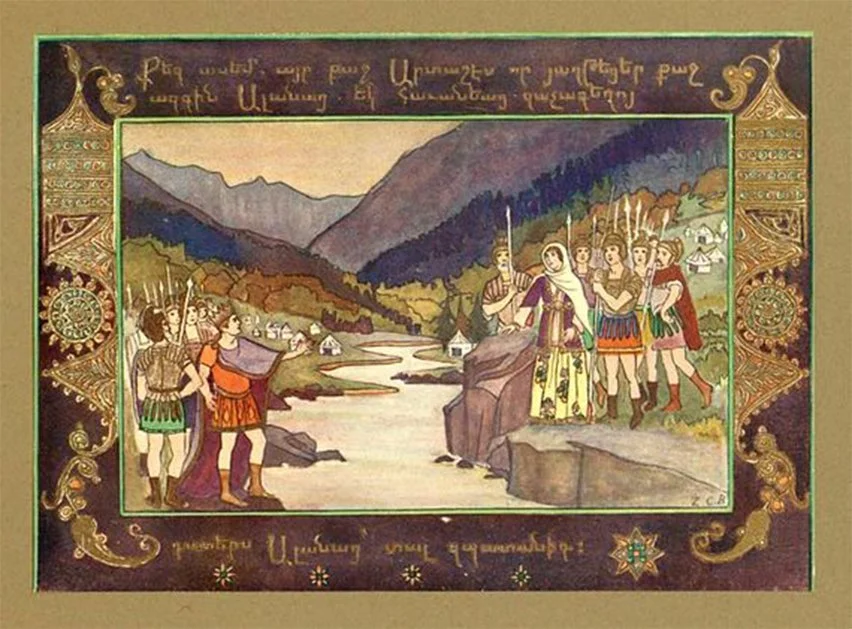

The book immediately attracted the attention of the British public and was highly appreciated in the local and Armenian media. The British Contemporary Review magazine wrote that “Armenian Legends and Poems” are “… a noble garland of Armenian flowers and a gallery of paintings presented to us by Miss Boyajian, paintings in which the pre—Raphaelite note is superbly dominant; pre—Raphaelite, that is, Byzantine or Armenian art.”
In the preface, Zabel wrote that her goal was to publish the book “as a monument to an unhappy nation,” and also indicated that she could prepare and publish a second volume. However, this did not happen. In an article about Zabel Boyajian published in the Ararat quarterly magazine in 1960, A. Bedikian noted that “Zabel’s own assessment of the book was not particularly high. According to him, Zabel believed that her creative genius was not properly recognized and the book was praised because of its Armenian origin. Until recent years, she refused to publish another edition of the book and complained that she had other works that needed to be published.
After the book was published, renowned Shakespearean scholar Sir Israel Gollancz asked Zabel to write a special poem dedicated to Shakespeare’s 300th birthday, which will be included in the book titled “Dedication to Shakespeare.” She immediately agreed and wrote a short poem, “Armenia’s Love for Shakespeare,” which, to Zabel’s great surprise, was read during the book’s presentation along with a poem by English novelist and poet Thomas Hardy. According to Bedikian, Zabel was very proud of this poem, as well as the fact that she was able to present Armenia in a book dedicated to Shakespeare’s memory. “I was asked to write for a large book dedicated to Shakespeare, to which many of the best writers in England and writers from almost all countries contributed. At the national holiday, two poems from the Book were read in the hall with all the foreign ambassadors and members of the government — one by Thomas Hardy, then the poet laureate, and the other by me,” Zabel wrote in a letter to Bedikian. Following the successful poem “Dedication to Shakespeare,” Zabel illustrated an Armenian translation of “Hamlet” for the Moscow Art Critics’ Edition in 1921.


In the 1920s, Zabel traveled extensively throughout Europe and was mainly engaged in landscape painting. According to Khorshidyan, she had solo and group exhibitions at the Fine Art Gallery on Bond Street in London, and she was also a member of the National Portrait Society and held exhibitions in Germany.
During a trip to Italy in 1923, Zabel Boyajian wrote a series of articles for Hayastani Kochnak magazine entitled “The Charm of Italy,” in which she shared her thoughts and impressions about Italians and beautiful landscapes. Zabel also spent several weeks in Venice and researched the archives of the Congregation of Mekhitarians on the island of St. Lazarus. At this time, Zabel met the Armenian writer Avetik Isaakyan and became friends with him. Years later, she translated his poem “Abu Lala Mahari” into English and published it in the American-Armenian media.
In 1924, Boyajian published Gilgamesh: A Dream of Eternal Search, which featured her version of the famous Akkadian epic and included her illustrations. In letters to Arshak Chobanyan and Avetik Isaakyan, Zabel wrote about how excited she was about the publication and how much she wanted Armenians to know about her work.
In 1928, she visited Egypt and held a solo exhibition in Cairo. In an article in the English-language Egyptian Sphinx magazine titled “The Artist and the Poet,” Zabel was described as a portrait painter and praised as an accomplished writer.
Throughout her life, Zabel earned her living by selling portraits and publishing in British and Armenian periodicals. She drew inspiration from visiting different places all over Europe, and later reflected this in her art. In 1938, after long travels through Greece and the Greek islands, she published a catalog of paintings and travel notes entitled “In Greece with a pen and Palette.”
Zabel Boyajian has never been married or had children. During World War II, she remained in London and continued to paint and paint. With the assistance of the Armenian Church in the USA, she published the play “Etchmiadzin”, which she hoped would be staged in Armenia. However, the play was staged only once in New York.
In later years, Zabel found happiness in constant correspondence with her friends around the world and expressed a desire to travel to Armenia. She died in 1957 at the age of 84 in a London hospital, leaving behind a legacy that includes paintings, unpublished writings and memoirs.

Unfortunately, many details of Zabel Boyajian’s life are unknown to us, as there is little information about her. Despite the fact that most of her activities are known to the general public, her character still remains a mystery to many. In one of her letters, she mentioned that she is a member of the Federation of Alpine and Mountain Clubs. She noted that she opposes feminism and is a pacifist. Zabel also knew six languages. But her personality has yet to be explored.…
Today, 17 of Zabel’s letters are kept in the Yeghishe Charents Literary and Art Museum, and her archive is located at the Zoryanovsky Institute. According to various sources, her paintings are scattered all over the world and are kept in private collections and galleries. Her portrait of Raffi is in the Yeghishe Charents Literary and Art Museum, and one of her paintings is in the National Gallery of Armenia.
As Bedikian later wrote: “Z. Boyajian did the same for the British and English-speaking people that Chobanian did for the French and French-speaking people. Both of them became great translators of Armenian life, thought, culture and art in two European centers — Paris and London.”
Source: Armenian Museum of Moscow and Culture of Nations
 armeniawiki